要点
- 「醤油ペロペロ事件」は、SNS時代の軽犯罪として消費される一方で、「可視化された社会」の構造を露わにした出来事でもあった。
- 円形の調理台を中心とする厨房システム、その構造は、効率化と演出を兼ね備えた「見せる調理場」であると同時に、(観)客を「見(張)る調理場」でもあった。
- スシロー事件が示したのは、匿名的な視線の拡散であり、それに呼応するように「公」の基盤が拡散していく社会の姿である。
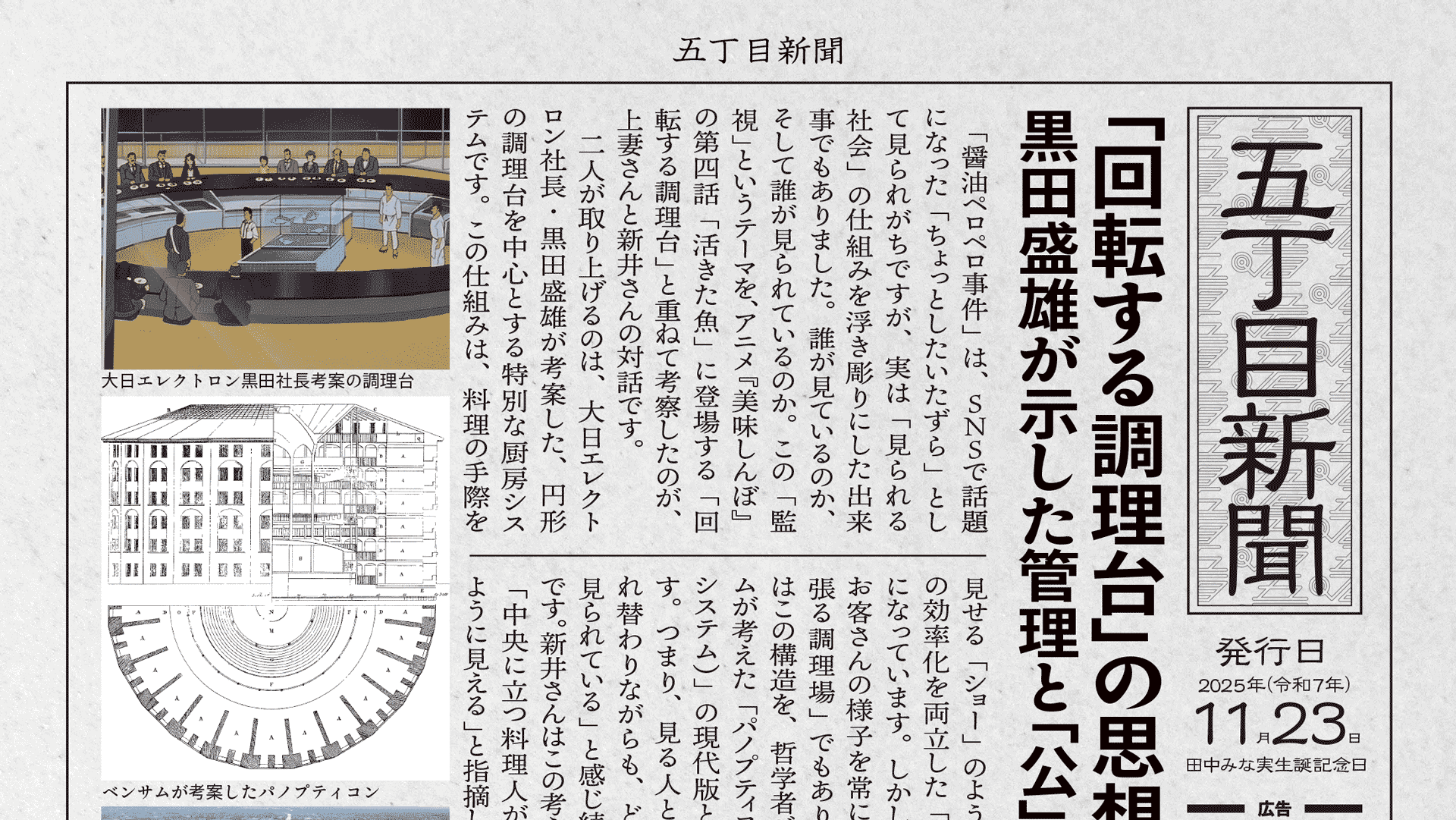
「醤油ペロペロ事件」は、SNS時代の軽犯罪として消費される一方で、「可視化された社会」の構造を露わにした出来事でもあった。だれが見ているのか、そしてだれが見られているのか。この「監視」の軸線を、アニメーション作品の第四話「活きた魚」に登場する「回転する調理台」へと重ね合わせて論じたのが、上妻氏と新井氏の対話である。
二人が言及するのは、大日エレクトロン社長・黒田盛雄のもとで登場した、円形の調理台を中心とする厨房システムである。その構造は、効率化と演出を兼ね備えた「見せる調理場」であると同時に、(観)客を「見(張)る調理場」でもある。上妻氏はこれを、ジェレミー・ベンサムが構想した「パノプティコン」の現代的転位として読む。
つまり、見る側と見られる側が常に入れ替わりながらも、それぞれが「誰かに見られている」という意識を内に持ち続ける構造である。新井氏はその読みを補強するように、「中央の料理人が支配者のように見える」と述べ、それを「支配的フォーメーション」と呼んだ。彼らの議論は、フーコーが『監獄の誕生』で論じた「権力の可視性と被視認性」の問題系を思わせる。
食という公共の場において、どこまで「演出」は「管理」と地続きなのか。黒田がつくり上げた回転装置は、単なる機能美を超え、外食産業における「秩序の形象」となっていた。
「円環」という建築的比喩
上妻氏は次に、スティーブ・ジョブズが設計理念に深く関与した米アップル社の本社「アップル・パーク」を取り上げる。「アップル・パークは巨大な円形で、中央に自然を配置している。構造的に『囲む円』という発想は共通している」と語る。
これに対し新井氏は、「ただしアップル・パークは逆手に取っている」と指摘する。すなわち、「偉い人が真ん中にいる」構造を反転させ、「“公” を中心に据える」設計意図である。もっとも新井氏は、そこに一抹の違和を覚える。「最初から“公っぽく” 設計された公には、権威主義的なにおいもある」と。この言葉には、フーコー的権力論を経た現代の「公共性」概念に対する批判的視線がにじむ。
上妻氏は「『公』は作るもの」と応じ、新井氏は「『私』から立ち上がるものだ」と返す。この応答の往復に、近代以降の「公/私」の二項対立が、再び問い直される気配がある。
「公」とはどこに立ち上がるのか
スシロー事件が示したのは、匿名的な視線の拡散であり、それに呼応するように「公」の基盤が拡散していく社会の姿である。
黒田盛雄が構想した円形の厨房装置は、意図せずして、この「見る/見られる」関係を先取りしていたとも言える。
かつてのように権力が中心に君臨することはなく、その場所はいまや空白のまま開かれている。
誰もが互いを見つめ合いながら、同時に「誰も中心にいない」⸺ そんな円環が続いている。
「回転する調理台」は、機械的な運動を通じて、私たちが日々生きる可視性の構造を象徴する。
そこには、監獄も、アップルの社屋も、そしてSNSのタイムラインも、一つの円環として重なり合う。
「公」は与えられるものではなく、円の外縁を歩きながら、私たち自身の手で立ち上げていくほかないのかもしれない。
本対談もまた、その外縁の歩みのひとつとして、『今日の士郎 美味しんぼ完全感想シリーズ① DangDang 気になる以前編』に収録されている。
For English-speaking readers
“The Idea of the ‘Rotating Cooking Counter’”— Management and the Concept of the “Public” Shown by Morio Kuroda
While the “soy sauce licking incident” was consumed as a minor crime in the age of social media, it was also an event that revealed the structure of a “visible society.” Who is watching, and who is being watched? The dialogue between Mr. Agatsuma and Mr. Arai discusses this axis of “surveillance” by linking it to the “rotating cooking counter” that appears in Episode 4 of the animated work, “Live Fish.”
They talk about a kitchen system that appeared under Morio Kuroda, the president of Dainichi Electron. It is a cooking space built around a round cooking counter. The structure is a “show kitchen” that mixes efficiency and performance. At the same time, it is also a kitchen that “watches” the customers. Mr. Agatsuma reads this as a modern version of the “Panopticon,” a model Jeremy Bentham planned.
In other words, the roles of the watcher and the watched keep switching, but each side still carries the feeling of “someone is watching me.” To support this reading, Mr. Arai says, “The chef in the center looks like a ruler,” and he calls it a “dominant formation.” Their discussion reminds us of Michel Foucault’s idea in Discipline and Punish: the problem of “visibility of power” and “being visible.”
In a public space of food, how far is “performance” connected to “control”? The rotating system that Kuroda created went beyond simple functional beauty. It became a “symbol of order” in the restaurant industry.
“An Architectural Metaphor: the Circle”
Next, Mr. Agatsuma talks about “Apple Park,” the headquarters of Apple in the United States, where Steve Jobs was deeply involved in the design idea. He says, “Apple Park is a huge circle, and nature is placed in the center. The idea of a ‘circle that surrounds’ is the same in structure.”
In response, Mr. Arai points out, “But Apple Park turns it around.” In other words, it flips the structure of “an important person in the center,” and aims to place “the public” in the center.Still, Mr. Arai feels a small discomfort.He says, “A ‘public’ space that is designed to look ‘public’ from the start can also smell a bit authoritarian.” In these words, we can see a critical view toward today’s idea of “publicness,” after the influence of Foucault’s theory of power.
Mr. Agatsuma replies, “The ‘public’ is something we make.” Mr. Arai answers back, “It rises from the ‘private.’” In this back-and-forth, we can feel that the modern opposition of “public/private” is being questioned again.
Where Does the “Public” Begin?
The Sushiro incident showed how anonymous eyes can spread, and how the base of the “public” can spread with them.
The round kitchen system that Morio Kuroda planned can also be seen as a device that, without meaning to, predicted this “watching/being watched” relationship.
Power does not sit in the center like before. That place is now open, but empty.Everyone looks at each other, and at the same time, “no one is in the center”. This circle keeps turning.The “rotating cooking counter,” through its mechanical movement, becomes a symbol of the structure of visibility we live in every day.In it, the prison, Apple’s headquarters, and the SNS timeline overlap as one circle.The “public” is not something we simply receive. Maybe we can only build it with our own hands, while walking along the outer edge of the circle.
This dialogue, too, is included in Today’s Shiro: The Complete Oishinbo Commentary Series (1) Before “DangDang, I’m Curious” as one step of walking along that outer edge.